With many policies nearing their end, buying a new energy vehicle may soon become more expensive.
Currently, over 20 cities across China have successively suspended or adjusted their car trade-in subsidy applications. For example, Hubei Province adjusted the distribution method of car trade-in eligibility vouchers in mid-November, distributing them in four batches daily, with the final batch on December 5th. Each batch of vouchers is available until all vouchers are claimed. Zaozhuang, Shandong Province, has implemented a quota management system for subsidy applications, distributing subsidy eligibility vouchers daily at 10:00 AM from December 1st to December 10th until the quota is exhausted.
More importantly, the policy of fully exempting new energy vehicles from vehicle purchase tax has less than a month left. According to the "Announcement on Continuing and Optimizing the Policy of Vehicle Purchase Tax Reduction and Exemption for New Energy Vehicles" jointly issued by the Ministry of Finance, the State Taxation Administration, and the Ministry of Industry and Information Technology in 2023, from January 1, 2026 to December 31, 2027, new energy vehicles will be subject to a 50% reduction in vehicle purchase tax, with a maximum tax reduction of 15,000 yuan per new energy passenger vehicle. This marks the official countdown to the end of the new energy vehicle purchase tax exemption policy, which has been implemented since September 2014 and has undergone several extensions, after more than ten years of operation.
With policy deadlines approaching, the auto market is heating up, with nearly 20 mainstream automakers launching purchase tax guarantee schemes. The core commitment focuses on delivery assurance: for orders placed before November 30th, if delivery is delayed into the new year due to the automaker’s own reasons, the automaker will fully bear the additional purchase tax costs incurred, thereby alleviating consumers’ concerns about purchasing a car.
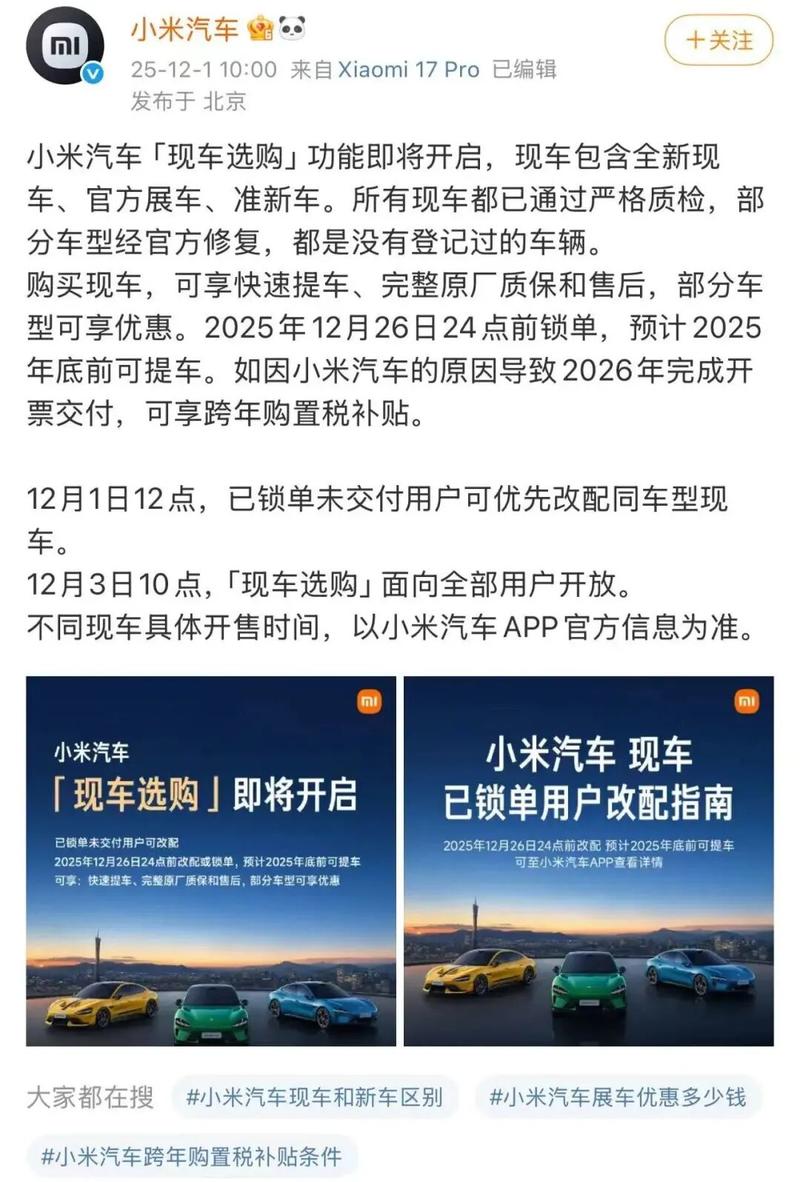
Image source: @Xiaomi Auto
Entering December, this wave of policy support has been further intensified. Brands including Xiaomi, Formula Leopard, and Changan Qiyuan have successively announced the extension of subsidy policies, extending the purchase tax support period from November 30th to the end of December, giving potential car buyers more time to make decisions at the end of the year.
The phase-out of multiple policy incentives means that the overall cost for consumers to purchase new energy vehicles will see a structural increase in 2026. However, industry insiders maintain a rational outlook, noting that competition in the domestic auto market has already reached a fever pitch, and the withdrawal of old policies does not mean the complete end of incentives. With changes in the market environment, automakers will likely introduce new terminal promotion strategies and product discount schemes to maintain market competitiveness.
Behind the "bottom line" of nearly 20 automakers
With the policy of halving the vehicle purchase tax for new energy vehicles set to take effect on January 1, 2026, coupled with the tightening of replacement subsidies in some regions, the new energy vehicle market is entering a critical window of opportunity for policy dividends. automakers are launching year-end "order-grabbing wars" to lock in customers.
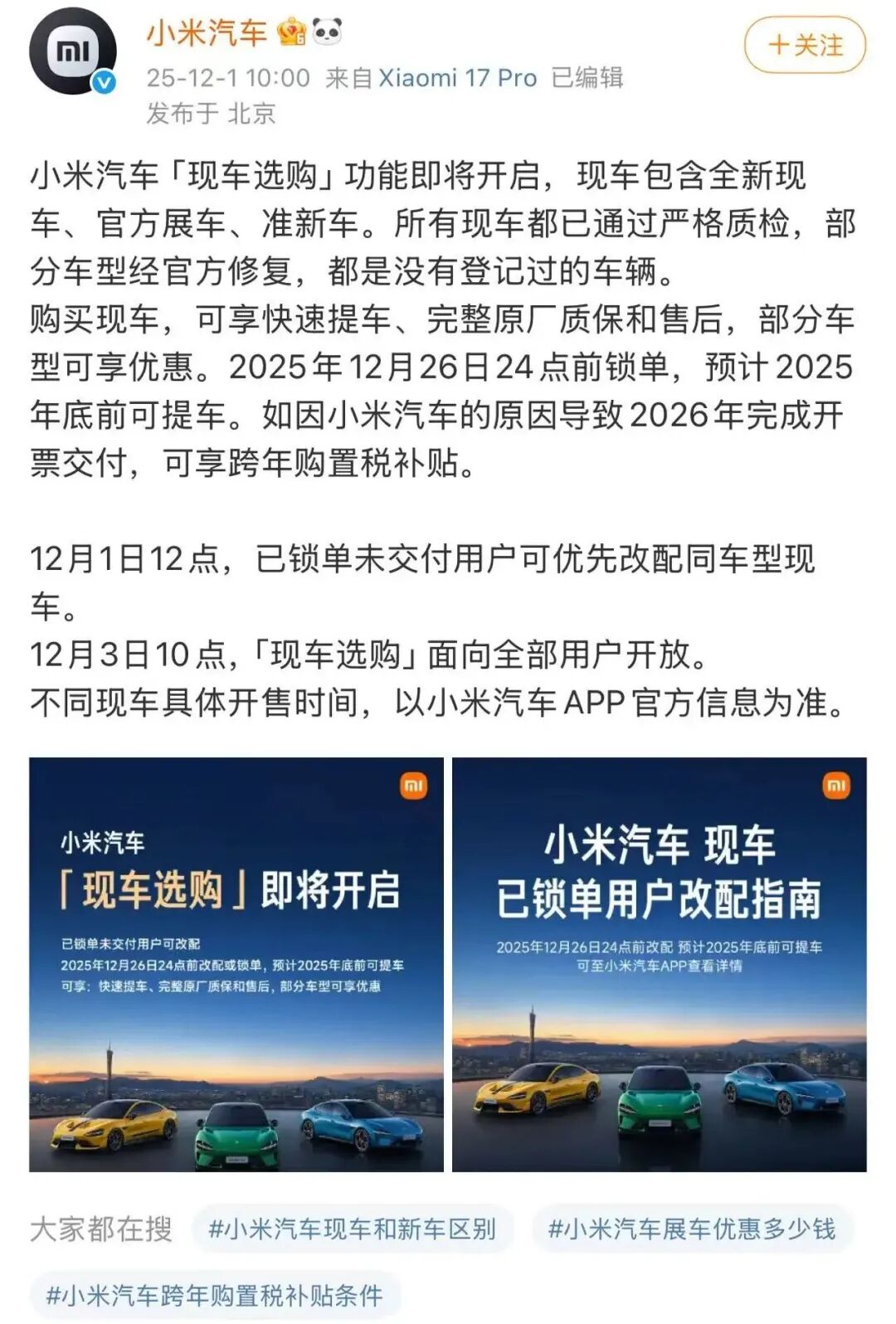
On December 1st, Xiaomi Auto’s official Weibo account stated that if customers change their vehicle configuration or lock in their order before 24:00 on December 26th, 2025, they are expected to be able to take delivery of their vehicles before the end of 2025. If, due to reasons attributable to Xiaomi Auto, invoicing and delivery need to be completed in 2026, they can enjoy a cross-year purchase tax subsidy.
On November 29th, Changan Qiyuan announced the launch of the new Q05 "Super Car Purchase Season" event: a fixed price reduction of 5,000 yuan for all models with no threshold for trade-in/additional purchase, while continuing the purchase tax guarantee policy until December 31st, and promising that for customers who have placed a large deposit, locked in an order, or received delivery before 24:00 on November 29th, the "highest amount refunded" policy will be implemented according to the new benefits of this "Super Car Purchase Season" event, and the difference will be refunded.
MG has also extended its purchase tax subsidy policy for the new MG4. To avoid a reduction in purchase tax benefits due to deliveries at the end of the year, MG has decided to extend the purchase tax subsidy policy from November 30 to December 28.
Prior to this, more than 20 mainstream automakers, including Li Auto, NIO, Chery, Wenjie, Xiaomi, Changan, and GAC, had successively launched purchase tax "safety net" schemes. The core terms of the relevant policies launched by the automakers are highly similar: most require consumers to lock in their orders before November 30th. If the vehicle is delivered and invoiced in 2026 due to reasons other than the user’s fault, such as production or transportation issues by the automaker, the automaker will bear the difference in purchase tax in the form of a reduction in the final payment, with a maximum subsidy of 15,000 yuan per vehicle.
In fact, the delivery cycle for many car models is currently as long as several months. For example, the delivery cycle for the Li Auto i6 is 16-19 weeks, and the delivery cycle for the Xiaomi SU7 PRO is 42-45 weeks. Cui Dongshu, Secretary-General of the China Passenger Car Association, said that due to policy adjustments, consumers feel a greater urgency to buy cars at the end of the year, and therefore consider the delivery time more when choosing a model. The guarantee policies offered by car manufacturers help alleviate consumers’ concerns.
Besides the vehicle purchase tax guarantee, some automakers are also offering special purchase benefits for December. Tesla is a prime example. On November 27th, Tesla China announced its December purchase benefits, covering all models including the Model 3, Model Y, and Model YL. Consumers who place orders before December 31st, 2025 (inclusive) can enjoy a 5-year 0% interest financing plan, an 8,000 RMB paint option bonus, and exclusive charging benefits. Those who drive away their Model 3 before December 31st (inclusive) can also enjoy an additional 8,000 RMB insurance subsidy.
"Taking advantage of the policy that halve the purchase tax subsidy for new energy vehicles, many automakers are making a final push, putting in their utmost effort to accelerate new product development and seize this policy dividend," said Shao Mingfeng, CBO and General Manager of Sales at Voyah Automobile.
"The reduction in the vehicle purchase tax policy is expected to boost market performance in the fourth quarter, especially with a possible ’tail-end’ rally in December. This is a normal market reaction during the policy transition period," said Lang Xuehong, deputy secretary-general of the China Automobile Dealers Association.
However, despite the positive news of order growth, automakers are facing the dual pressures of production capacity bottlenecks and rising costs. Affected by a surge in end-user orders and a contraction in upstream supply, lithium battery raw material prices have recently rebounded sharply. Data from the Shanghai Nonferrous Metals Market shows that the average price of lithium hexafluorophosphate reached 122,000 yuan per ton in mid-November, an increase of over 100% compared to 60,000 yuan per ton in early October; lithium carbonate prices have also cumulatively increased by about 20%. Li Liangbin, Chairman of Ganfeng Lithium, predicts that global lithium carbonate demand growth is expected to reach 30%-40% in 2026, reaching 1.9 million tons, while the increase in supply can only match 25% of the demand growth. If demand exceeds expectations, lithium prices are likely to break through 150,000 yuan per ton, and may even challenge the 200,000 yuan per ton mark.
The impact of cost pressures varies across automakers of different sizes. NIO CEO William Li stated that because the group’s models can utilize a battery leasing model, battery costs are not included in the tax base, thus the impact of the purchase tax reduction on the company is relatively small. However, for small and medium-sized automakers, they have to bear the maximum purchase tax subsidy of 15,000 yuan per vehicle while also coping with rising raw material prices, severely compressing their survival space. Industry insiders estimate that for a new energy vehicle priced at 300,000 yuan, the 15,000 yuan subsidy will directly eat up about 50% of the profit per vehicle, and some smaller brands have already suspended promotions due to their inability to afford the subsidy.
Industry profitability data also confirms this pressure. According to data disclosed by Cui Dongshu, in October 2025, the automotive industry’s sales profit margin was 3.9%, a decrease of 0.5 percentage points compared to September, reaching the lowest level in the same period in five years. From January to October 2025, the automotive industry’s sales profit margin was 4.4%, better than in 2024, but still at the second lowest level in history.
From "policy-driven" to "market-driven"
Trade-in programs are a key driver of consumer spending in the automotive industry this year. To further boost consumption and stabilize the macroeconomy, the central government issued 300 billion yuan in ultra-long-term special treasury bonds this year, one of the core uses of which is to support trade-ins of consumer goods, a tangible benefit to the public. Trade-ins and replacements of old vehicles in the automotive sector are among the areas supported by these subsidies. Data from the Ministry of Commerce shows that in the first 11 months of this year, trade-ins of consumer goods boosted sales of related products by over 2.5 trillion yuan, benefiting over 360 million people. Among these, over 11.2 million vehicles were traded in.
It is worth noting that, alongside the trade-in policy, there is also a tiered adjustment to the purchase tax reduction policy for new energy vehicles. Industry experts believe that this tiered reduction in the purchase tax is not simply a policy "ebb," but rather signifies that China’s new energy vehicle industry is transitioning from a growth phase supported by policy to a new stage of large-scale, high-quality development.
The profound shift in policy direction is reflected in the increased technological threshold. The Ministry of Industry and Information Technology, along with two other departments, jointly issued the "Announcement on Technical Requirements for New Energy Vehicle Products Subject to Vehicle Purchase Tax Reduction and Exemption in 2026-2027," clarifying that from 2026 onwards, the pure electric range of plug-in hybrid (including range-extended) passenger vehicles should be no less than 100 kilometers, a significant increase from the current requirement of 43 kilometers. Furthermore, the new regulations also impose higher requirements on indicators such as vehicle curb weight and energy consumption. According to industry analysis, approximately 30% of plug-in hybrid models may enter a production halt and inventory clearance phase due to their inability to meet the new regulations.
Image source: Li Auto
Many automakers have made ample preparations for the policy changes. Li Auto President Ma Donghui stated at the Q3 earnings conference that the reduction in the vehicle purchase tax policy may lead to a "tail-end effect" at the end of 2025, with users locking in discounts, which could then cause a quarter-on-quarter sales decline in the first quarter of 2026. However, he also emphasized that he remains optimistic about the long-term penetration rate of new energy vehicles, predicting that the domestic new energy vehicle penetration rate will reach 55%-60% by 2026. This assessment is shared by most automakers—the short-term rush for orders is to smoothly navigate the policy transition period, while the core of long-term competition still lies in building core capabilities such as battery technology upgrades and intelligent experience optimization.
Data from the China Association of Automobile Manufacturers (CAAM) shows that from January to October 2025, China’s automobile production and sales reached 27.692 million and 27.687 million units respectively, both representing year-on-year growth of over 10%. Among them, the production and sales of new energy vehicles (NEVs) reached 13.015 million and 12.943 million units respectively, representing year-on-year growth of 33.1% and 32.7%. Chen Shihua, Deputy Secretary-General of CAAM, explained that since 2025, NEVs have continued to achieve high growth. This is due to two main factors: firstly, the continued effectiveness of the domestic vehicle trade-in subsidy policy, which is substantial and widely beneficial, has driven the high growth of the NEV market; secondly, the halving of the purchase tax on NEVs in 2026 has led some consumers to purchase vehicles in advance, ushering in a new wave of consumption in the NEV market.
"As the first year of the ’15th Five-Year Plan,’ promoting consumption will remain one of the key tasks in 2026," Chen Shihua said. He also added, "Considering that the purchase tax on new energy vehicles will be halved next year, to reduce market volatility, it is recommended that relevant automobile policies be further optimized and implemented next year, and that detailed implementation rules be released as soon as possible to stabilize market expectations and promote the smooth operation of the industry."
(Original title: Is it too late if you don’t buy now? More than 20 cities adjust national subsidies)